


Lunation Calendar — Deep Dives — Location
The sky is shared; every view of it is local.
Some astronomical events occur at the same instant everywhere, but their local time, calendar date, and appearance depend on where they are observed. Full Moon, for example, occurs at one moment, when the Moon lies opposite the Sun in its phase cycle. That moment may carry a different clock time—or even a different date—depending on the observer’s time zone and daylight-saving rules. When the Full Moon reaches its highest point in the local sky depends largely on longitude; how high it climbs and when it sets also depend on latitude and the local horizon.
A view from one place
Latitude and longitude place an observer on Earth. Longitude measures position east or west, shifting the local timing of the sky as Earth turns. Latitude measures position north or south, changing the angle at which the paths of the Sun, Moon, and planets meet the horizon. Together with the local horizon, these coordinates shape what rises, how high it climbs, how long it remains visible, and where it sets.
The Netherlands Edition is calculated for the Westertoren in Amsterdam, whose meridian historically defined Amsterdam Time—the civil-time reference once used throughout the Netherlands.
Time zone and daylight-saving rules do a different job: they translate astronomical instants into local clock times and calendar dates. Both the Lunation Chart and Year Chart name the location whose coordinates, horizon, and civil time govern these local features. The Lunation Chart’s central Orbit Diagram also marks the location’s latitude.
Other patterns do not move when the observer does. The Moon reaches a phase, crosses the ecliptic, or enters a zodiac sign at the same astronomical instant for every location. Changing the location changes the date or time printed for that instant, and sometimes whether the event can be seen, but not the underlying event.
How much location matters
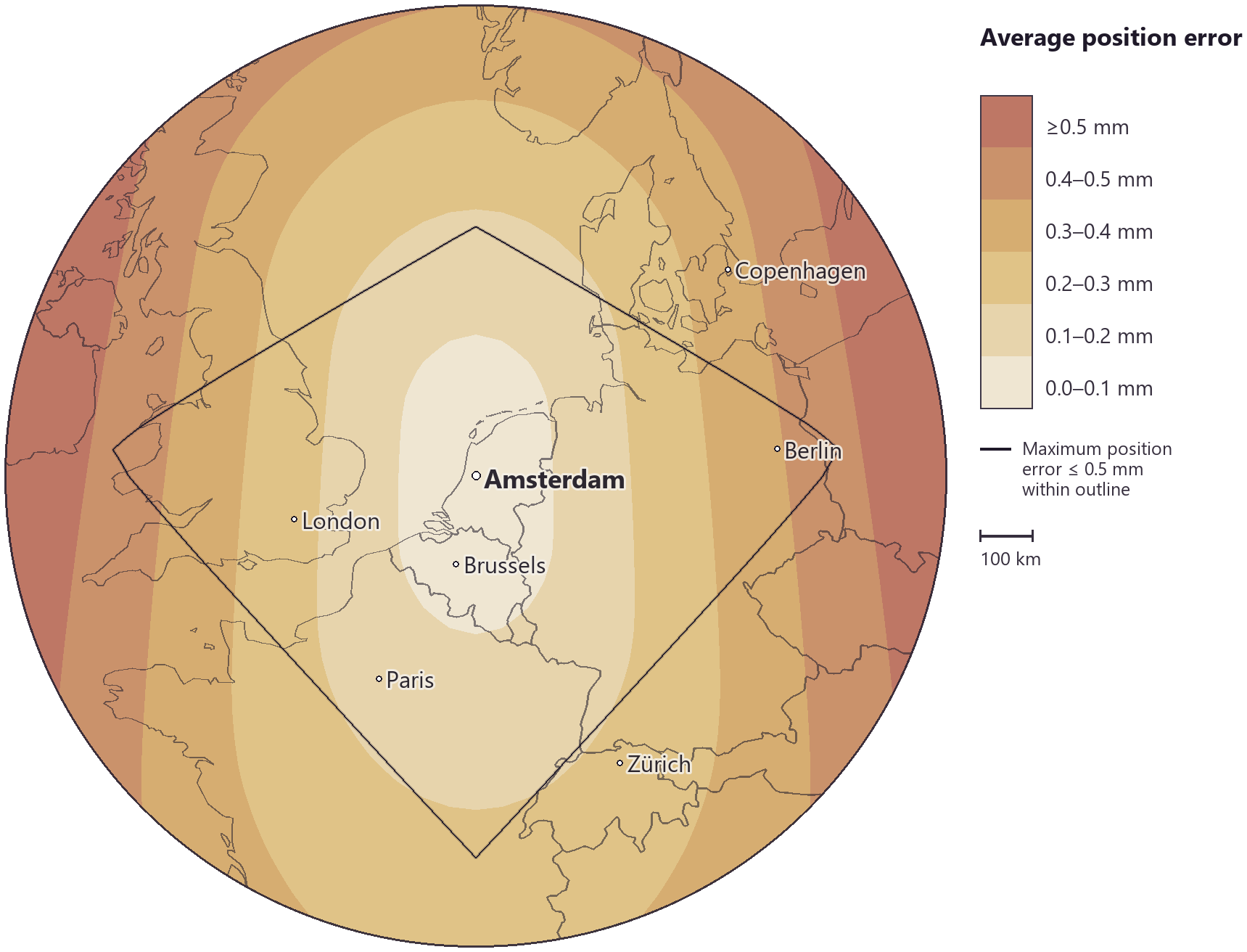
Location dependence is usually a matter of degree. Earth turns through one degree of longitude in about four minutes, so moving one degree east or west shifts the local passage of the sky by about four minutes. A short move therefore makes a small difference to rise, culmination, and set times; a journey across many degrees makes a larger one.
Latitude has an equally direct effect on height. For a body at a fixed declination—its north-south position in the sky—moving one degree north or south generally changes its height at culmination by about one degree. Its time above the horizon changes less evenly. At the June solstice, for example, the Sun spends about 12 hours above an ideal horizon at the equator, 14 hours at 30° north, 16 hours at 50° north, and 18½ hours at 60° north. The Moon follows the same geometry, but its path shifts more noticeably from one day to the next.
Some effects have thresholds. Near the horizon, a small change in location can decide whether an event is visible at all. Crossing the edge of a solar eclipse or occultation path can turn a near miss into an overlap. Crossing a time zone or daylight-saving boundary can change the printed clock time abruptly, even when the locations are close together. How sensitive a chart feature is therefore depends on both the distance moved and the boundary nearby.
Across the local sky
As Earth turns, the Sun and Moon appear to rise, climb to a highest point, and set. That highest point is called culmination. Longitude helps determine when each stage occurs; latitude and the horizon shape the height and length of the arc above the horizon. During the same lunation, the Moon can therefore pass high overhead in one place, skim low across the sky in another, or spend very different amounts of time above the horizon.
The Lunation Chart’s Moon and Sun Arcs Band traces these daily journeys in blue and gold. The Moon Faces Band shows the Moon at culmination, including the roll that turns its face to the orientation seen from the chart location.
That Moon image is local in orientation, but not in every detail. Its phase and libration are calculated from the center of Earth rather than fully rerendered from the observer’s exact position on the surface. The distinction is subtle, but it marks the limit between a locale-adjusted chart image and a fully topocentric view.
Visible from here
An event can occur globally without being visible locally. It may happen while the relevant bodies are below the horizon, or its path may cross a different part of Earth. Location can also change the bodies’ apparent spacing, especially when the nearby Moon is involved.
A solar eclipse is visible only along part of Earth’s surface. A lunar eclipse can be seen wherever the Moon is above the horizon, but a particular place may see only part of it. The Solar Eclipse and Lunar Eclipse Rare Events distinguish the shared event from its local visibility and contact interval. When an eclipse is visible, the Lunation Chart’s Moon Faces Band depicts the locally visible geometry. The Eclipses Deep Dive follows this relationship from orbital alignment to the view from Earth.
Moon-planet conjunctions make perspective especially tangible. Because the Moon is nearby, it may pass in front of a planet from one location and just beside it from another. The Moon-Planet Conjunction Rare Event can record local details such as apparent proximity, occultation, and contact times. The charts also calculate apparent overlaps and contacts from the chart location for planet-planet and Sun-planet conjunctions, though these usually change less over modest distances.
From an instant to a date
Astronomical events are calculated as instants, but charts are read through local clocks and calendars. A Full Moon that occurs late in the evening at one location may already belong to the next Gregorian day somewhere farther east. The Lunation Chart’s Gregorian Date Band and the Year Chart’s Gregorian Month Band place those instants within the calendar of the chart location.
Local clocks are not uniform throughout the year. When daylight-saving time begins or ends, the Daylight-Saving Time Transition marks the change in the location’s civil clock.
Location can also supply a cultural boundary rather than the instant of an astronomical event. The Wheel-of-the-Year Festival spans begin at the preceding local sunset and end at local sunset on the festival date. The astronomical crossing is shared; the sunset-to-sunset observance belongs to a particular horizon.